Mohamed Ahmad and Helen Zhou, A4
The effects of guilt are profound in the play, Macbeth. This page analyzes the passages that portray the effects of guilt on the major characters within the play.
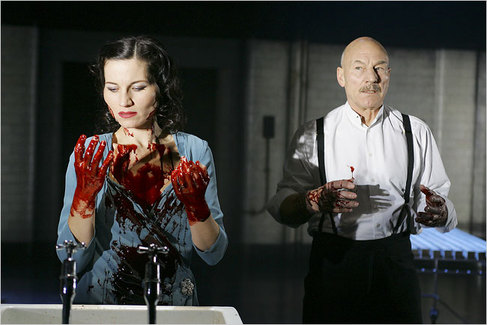 | Key Ideas
|
Supporting Quotes
- “Unnatural deeds / Do breed unnatural troubles.” (5.1.75-6)
- "Come, you spirits / That tend on mortal thoughts, unsex me here, / And fill me from the crown to the toe top-full / Of direst cruelty." (1.5.47-50)
- "DOCTOR: How came she by that light? / GENTLEWOMAN: Why, it stood by her. She has light by / Her continually. 'Tis her command." (5.1.23-5)
- "Here's the smell of the blood still. All / the perfumes of Arabia will not sweeten this little / hand. O, O, O!" (5.1.53-5)
- "Ay, and since too, murders have been performed / Too terrible for the ear." (3.4.93-4)
- "Avaunt, and quit my sight! Let the earth hide thee. / Thy bones are marrowless; they blood is cold; / Thou hast not speculation in those eyes / Which thou dost glare with." (3.4.113-6)
- "Then live, Macduff; what need I fear of thee?" (4.1.93)
- “Till Birnam Wood remove to Dunsinane/I cannot taint with fear. What’s the boy Malcolm?” (5.3.2-3)
- “Give me my armor…Hang those that talk of fear. Give me mine armor” (5.3.39-44).
- “…she is troubled with thick-coming fancies/That keep her from her rest” (5.3.47-8).
- “I have done the deed. Didst thou not hear a noise?” (2.2.19)
- “What hands are here! Ha, they pluck out mine eyes./Will all great Neptune’s ocean wash this blood/Clean from my hand?” (2.2.77-9)
- Lady Macbeth’s masculinity, wishing she had killed him: “My hands are of your color, but I shame/To wear a heart so white” (2.2.82-3).
- Lady Macbeth starting to become a more feminine figure: “You must leave this” (3.2.40).
- “O, full of scorpions is my mind, dear wife!” (3.2.41).
MIP
(5.1.23 - 55)
How came she by that light?Gentlewoman
Why, it stood by her: she has light by herDoctor
continually; 'tis her command.
You see, her eyes are open.Gentlewoman
Ay, but their sense is shut.Doctor
What is it she does now? Look, how she rubs her hands.Gentlewoman
It is an accustomed action with her, to seem thusLADY MACBETH
washing her hands: I have known her continue in
this a quarter of an hour.
Yet here's a spot.Doctor
Hark! she speaks: I will set down what comes fromLADY MACBETH
her, to satisfy my remembrance the more strongly.
Out, damned spot! out, I say!--One: two: why,Doctor
then, 'tis time to do't.--Hell is murky!--Fie, my
lord, fie! a soldier, and afeard? What need we
fear who knows it, when none can call our power to
account?--Yet who would have thought the old man
to have had so much blood in him.
Do you mark that?LADY MACBETH
The thane of Fife had a wife: where is she now?--Doctor
What, will these hands ne'er be clean?--No more o'
that, my lord, no more o' that: you mar all with
this starting.
Go to, go to; you have known what you should not.Gentlewoman
She has spoke what she should not, I am sure ofLADY MACBETH
that: heaven knows what she has known.
Here's the smell of the blood still: all the
perfumes of Arabia will not sweeten this little
hand. O, O, O!
Talking Points:
- Juxtaposition of light (symbolizing purity and protection) and dark. Lady Macbeth is afraid of the dark, displaying a shift in her characterization. She also attempts to keep herself morally justified.
- Shift in characterization: A reversal of her role and Macbeth's role is emphasized, as she appears more feminine and fearful of "manly" actions, such as cruelty and violence.
- Motif of Blood: Lady Macbeth attempts to wash off the blood (which symbolizes her guilt over Duncan and other's murders) that haunts her constantly.
- The smell of the blood also symbolizes the everlasting guilt. She contrasts it with the sweet smells of Arabia, and how the smell of blood is more powerful.
- Lady Macbeth's mind holds her accountable for her actions, as opposed to the physical evidence that could incriminate her.
Thesis Statement
In Shakespeare's play, Macbeth, the motif of blood and guilt is used to represent the everlasting mental effects that result from incriminating actions, joined by character transformations from the overwhelming guilt.
